After a few years of hearing nothing, and then “There will be no Raspberry Pi 5 in 2023” we have a Raspberry Pi 5. Surprise! This means that it’s time for me to test and let you know what the best Raspberry Pi 5 microSD cards are from my exhaustive collection. Will the usual suspects be at the top? Will the Pi 5 surprise us with its microSD card speeds?
If you don’t yet have the Pi 5, I have articles covering the best Raspberry Pi 4 microSD cards, as well as general single-board computer microSD benchmarks! And if you’re looking to see how the Raspberry Pi 5 performs as a whole, check out my comprehensive Raspberry Pi 5 Review & Comparison.
Table of Contents
Raspberry Pi 5 SD card: What To Buy
If you just want a recommended SD card for Raspberry Pi 5, here’s the short version.
Best overall: Amazon Basics (64GB) – fastest random I/O in my tests, ideal for desktop use or running Raspberry Pi OS day-to-day.
Best value: Intenso (64GB) – slightly slower than the Amazon Basics but still solid performance at a lower price per GB.
Best endurance: SanDisk MAX ENDURANCE (32GB) – designed for constant writes like camera recordings, Home Assistant logs, or anything that’s going to be hammering the card.
The thing to understand about SD cards for the Pi is that random read/write speeds matter more than the big sequential numbers you’ll see plastered on the packaging. A card optimised for cameras might look fast on paper but feel sluggish when you’re actually using it as an OS drive. The A1 or A2 rating and the quality of the card’s controller affect how snappy your system feels, not just the headline MB/s figures.
Recommended SD card size for Raspberry Pi 5
For most Raspberry Pi 5 users, a 64GB card hits the sweet spot between price, performance, and having enough space to not worry about running out.
Basic learning / single project: A 32GB card will handle Raspberry Pi OS plus your logs and a few projects comfortably. You can even get away with 16GB if you’re doing something minimal, though be aware that smaller cards are often noticeably slower.
Desktop-style daily use: Go for 64GB. This leaves you with plenty of headroom for system updates, package caches, and general use without constantly checking your disk space. The Amazon Basics 64GB that topped my benchmark tests is inexpensive enough that trading down for a slower, smaller card doesn’t make financial sense for most people.
Heavy development / many images / Docker: You’re looking at 128–256GB, or honestly, just use NVMe instead. Running multiple containers or keeping several OS images around will chew through space quickly, and at that point the performance benefits of NVMe are worth the extra cost of a HAT.
Is 32GB enough for Raspberry Pi 5?
Yes, for basic use. Raspberry Pi OS will fit with room to spare, but you won’t have loads of space left over for additional packages or media files if that’s your kind of thing.
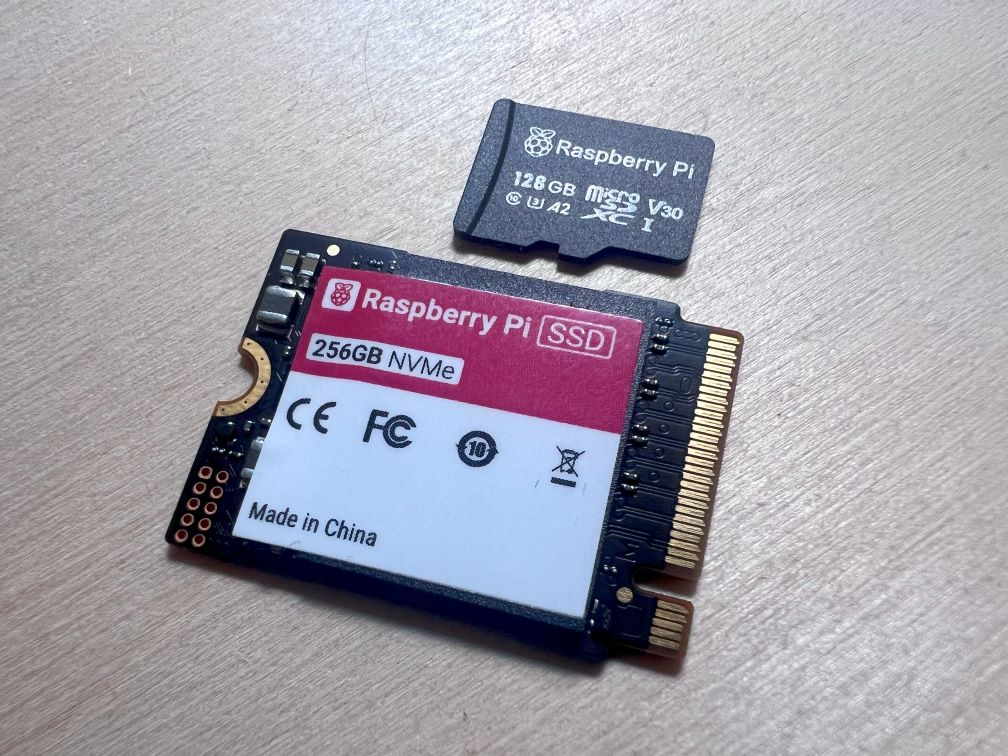
Should I buy 256GB or use NVMe instead?
If you’re considering a 256GB+ microSD card, you should probably be looking at NVMe options. The performance difference is significant and you’ll get better value for money with an M.2 drive and HAT.
Raspberry Pi 5 microSD Card Benchmarks
I’m going to be using fio to run the usual sequential read, sequential write, random read, and random write tests with a 4KB block size to be able to compare with those I’ve done in other tests. These are all performed on an ext4 filesystem with a partition spanning the entirety of the disk.
Each test is then run 5 times, with the average of those 5 runs being the data you see below. It’s worth remembering that the sequential read and write speeds are not the most important thing when it comes to everyday usage. The random reads/writes are going to be a better number to look at, though the sequential speeds don’t hurt, obviously!
Fastest microSD Cards for Raspberry Pi 5
And the winner of Bret’s Best Raspberry Pi 5 microSD Card is..
1st Place: Amazon Basics (64GB)
Our old friend, the Amazon Basics microSD card, sits at the top of yet another “Best Of” test, only falling behind on the sequential read speeds, where the Transcend (32GB) card hit an impressive 78.46MB/s. The 128GB model was very close, though I feel it’s a little unfair to put them both up here so based on value, I’ve selected the 64GB option as my number 1.
2nd Place: Intenso (64GB)
Taking an overall 2nd place thanks to great random read/write speeds, we have the Intenso (64GB) microSD card. It’s not the most well-known brand, but it’s holding its own here!
3rd Place: Transcend (32GB)
It was super close between the Transcend (32GB) and Samsung PRO Plus (128GB) for 3rd place but thanks to the Transcend’s slightly higher random write results, I’ll go with that. It was extremely close though and if you trust Samsung as a brand over Transcend, it may still be your choice.
Maximum microSD size on Raspberry Pi 5
The Raspberry Pi 5 supports standard microSDHC and microSDXC cards, so in practice it can use cards up to at least 128GB without issue, and larger capacities should work fine assuming you’re using a supported filesystem.
The spec side of things is straightforward: SDHC covers cards up to 32GB, while SDXC handles everything from 32GB up to a theoretical 2TB. The Pi 5 uses a microSDXC-capable slot, so the limiting factor is usually the quality of the card itself and your filesystem choice rather than the slot.
In the benchmarks on this page, I’ve tested cards up to 128GB. Larger capacities should behave similarly and I’ve seen people mention using 256GB and even 512GB cards successfully, but I haven’t personally verified those in my testing setup, so take that as anecdotal rather than super-scientific-lab-confirmed.
What is the maximum SD card size for Raspberry Pi 5?
Technically up to 2TB based on the SDXC spec, though realistically most people won’t need anywhere near that.
Does Raspberry Pi 5 support 1TB microSD cards?
The slot should handle them just fine, but you’re entering territory where NVMe makes more sense from both a performance and value perspective.
What size should I actually buy?
- 32–64GB: Fine for learning projects, retro gaming with RetroPie, basic tinkering.
- 128–256GB: Good if you’re running emulators with lots of legally obtained ROMs, storing lots of media files, or have a more desktop-like setup.
- Above that: You’re probably better off with an NVMe drive via a HAT rather than spending money on a massive microSD card.
Best Raspberry Pi 5 microSD Card
Having mentioned the brand trust aspect in the last section, I feel it’s fair to point out that whilst I do my best to test as clearly as possible, these numbers don’t always tell the same story. Typically, the well-known brands are going to fare better in the long run, so picking a brand you trust, or have had a good track record with in the past may be more important to you than a number being slightly bigger in a table, and that’s perfectly fine!
The best Raspberry Pi 5 microSD card is always going to be subjective, so hopefully, the wide range of numbers across some of the most popular brands and models will help you to choose the best microSD Card for the Raspberry Pi 5 that’s just dropped on your doorstep.
For me, I fully endorse the Amazon Basics microSD card range and whilst at first, I was sceptical, they’ve continued to top the tables in my tests. I even tried to catch them out by ordering from 3 different storefronts over the course of 18 months and they’re all high-quality cards that reach the same numbers.
Do you have a favoured brand when it comes to microSD cards for your single-board computers? Let me know in the comments! I’d love to know if there’s a brand/model I’m missing out on and who knows, I may add it to my testing suite, I have 7 spaces in my microSD card holder..
How fast is the Raspberry Pi 5 microSD slot?
In real-world tests, the Raspberry Pi 5’s microSD slot delivers around 67 MB/s sequential read and 41 MB/s sequential write with a fast UHS-I card like the Amazon Basics 64GB, and roughly 23 MB/s for 4K random reads and 7 MB/s for random writes.
Those numbers represent what you’ll actually see with a good card, and the Pi 5’s slot is usually the bottleneck, not the card itself. Even if you buy a faster UHS-I card, you’re not going to see dramatically different results because you’ve hit the slot’s limits. UHS-II cards exist and they’re faster, but they’ll fall back to UHS-I speeds in the Pi 5 anyway, so save your money.
The sequential speeds are fine for loading large files, but what actually matters for day-to-day use is the random I/O performance. Those 4K random read/write numbers determine how snappy your system feels when you’re booting up, running apt upgrade, or using the desktop. This is why cards optimized for cameras can look impressive on paper (great sequential writes for video recording) but feel sluggish when used as an OS drive – their random I/O performance is often terrible.
All the results in the benchmark table below were measured using fio with 4KB blocks, iodepth 64, and a 1GB test file. Each card was tested 5 times and the numbers you’re seeing are the averages.
What is the maximum SD card speed on Raspberry Pi 5?
Around 78 MB/s sequential read (achieved by the Transcend 32GB in testing), though realistically most cards will hit 60-70 MB/s. Random I/O varies more widely and matters more for actual performance.
Does Raspberry Pi 5 support UHS-II microSD cards?
You can use them, but they’ll run at UHS-I speeds. The slot doesn’t support UHS-II, so you’re just paying extra for performance you won’t get.
Is it worth paying extra for the fastest microSD card?
Up to a point. The difference between a cheap no-name card and something like the Amazon Basics is huge. The difference between the Amazon Basics and a premium card that costs twice as much? Minimal, because you’re hitting the slot’s limits.
Raspberry Pi 5 microSD requirements (speed class & compatibility)
The Raspberry Pi 5 works with standard microSDHC and microSDXC UHS-I cards. Higher speed ratings only help if they translate into better random I/O performance, which many “fast” cards don’t actually deliver.
What to look for on the label
- UHS-I logo (I) – Anything slower than this isn’t worth buying in 2024/2025. You want the single “I” symbol.
- Application class A1 or A2 – This rating is designed for app workloads with small random reads and writes. The Pi 5 handles A2 cards without issue (Raspberry Pi’s own microSD cards are A2-rated), so either is fine from known brands.
- Avoid no-name brands – Unbranded cards from unknown manufacturers often underperform their stated specs or fail early. Stick with Amazon Basics, Samsung, SanDisk, Transcend, Kingston, or similar established names.
A1 vs A2:
The Pi 5’s controller has no trouble with A2 cards, though you might hear stories about older Raspberry Pi models having issues with certain A2 cards. That’s generally not a Pi 5 problem. Both A1 and A2 from reputable brands will work fine – the Amazon Basics card that topped my tests is A2-rated.
Compatibility and failure symptoms:
Even cards that look good on paper can have issues. Some batches of budget cards (yes, even from recognizable brands) can suffer from manufacturing variation. Signs of a problematic card include:
- EXT4 filesystem errors during boot
- “mmc0: card stuck being busy” errors in logs
- Repeated
fsckissues or filesystem corruption - Random crashes or instability under load
If you’re seeing these symptoms with a brand-new card, try a different one. Sometimes it’s just a bad batch.
Which type of SD card does Raspberry Pi 5 use?
MicroSDHC or microSDXC with UHS-I support. Look for A1 or A2 application class ratings from known brands.
Does Raspberry Pi 5 support A2 microSD cards?
Yes, the Pi 5 handles A2 cards without problems. The top performer in my tests was A2-rated.
Which SD cards are compatible with Raspberry Pi 5?
Any reputable brand’s microSDHC or microSDXC UHS-I card should work. I’ve tested Amazon Basics, Samsung, SanDisk, Transcend, Kingston, and others without compatibility issues.

23 comments
I have a lot of PNY. They’re usually the cheapest I find, and haven’t let me down yet. The pi has been the bottleneck though. Lately I’ve been stocking up on Samsung. Looks like they should do well when I get my pi5.
Hah! I did have a PNY card in my initial fleet of benchmarking microSD cards but it died after about 5-6 tests annoyingly. Most of the Samsung ones will do just fine, yup!
Test Kingston SDCIT2/64GB (or 32GB)
I’d love to test every available card but unfortunately I don’t have any plans to purchase any new ones at the moment. I’ve added the 32GB model to my wishlist at https://www.amazon.se/hz/wishlist/ls/7JG01YVBN93M though so if you/someone else wants me to test a specific card, buying it from there will enable that and I’ll test it in the board(s) requested :)
That surprised me the Sandisk HE took that big of a performance hit whereas the Samsung HE did not. Do you know if these tests are indicative of the performance of these cards as a whole regardless of platform?
I wish your post elaborated on how you ran fio, so I could test my sd card and see how far off the results could be.
After testing cards on a Pi 4, the one test I trust most is a complete install of a big software, such as Libreoffice (or whatever), it really slowed down my old Samsung Pro card that was really fast in other tests. The card was good for a camera, great even, but bad for Pi when updating or installing.
Yup, that’ll be the random reads/writes that will be much slower than those you’d find in a camera which is just writing sequentially!
What was the testing method used here for reference?
Hi! For this piece I was using
fioand the full command would befio --randrepeat=1 --ioengine=libaio --direct=1 --gtod_reduce=1 --name=test --filename=mount/test --bs=4k --iodepth=64 --size=1G --readwrite=XXXXXwhere XXXX at the end is either read, write, randread, or randwrite. Names/filenames are likely a little redundant there and you may want to remove/change them based on your setup if you’re going to repeat the test!Just bought an Amazon Basics (64GB) after reading your tests. Installed the latest raspberry pi os on it and inserted it into my new raspberry pi 5. Got lots of ext4-fs errors just after a few days. It auto repaired a few times during boot at first. But now it just dont finish booting any more.
Either my new rpi5 is broken, or the SD card Amazon Basics (64GB) sucks…
Oh! It could be a few things I guess. I have 8-9 of these from various batches and bought from various regional storefronts in “production” at the moment and I’m yet to have an issue (well, one was DoA but Amazon quickly replaced).
Have you tried re-flashing the card and seeing if it still works then? What were you running on the Pi itself out of curiosity? Was it anything particular disk intensive? I’d be curious to know what errors you were getting exactly, and perhaps the additional details on the disk (I think sbc-bench with -S still works to get this, or PiBenchmarks disk test will show it) to see when it was made and by who. It’s possible Amazon are swapping manufacturers out (which is why I regularly buy from multiple storefronts so I can check and re-test if necessary) so that’d be a good check.
What I got from lshw : vendor:Unknown(173), version:1.0, date:12/2023.
The most disk intensive task I can think of was encrypting the rootfs via cryptsetup (ISO-flash + cryptsetup, 3 times, to find the right settings for rpi-os-bookworm).
Once the filesystem was encrypted, I apt installed a bunch a software, switched back to Openbox desktop, updated some scripts via Geany, watched a few videos online via Firefox, and did some remote gaming via Moonlight-qt.
I ISO-flashed + cryptsetup the card again, and after a few hours and reboots, got fs errors again.
This time I saved them :
[ 91.714684] EXT4-fs error (device dm-0): ext4_lookup:1855: inode #390575: comm pool-pcmanfm: iget: bad extra_isize 32699 (inode size 256)
[ 141.750361] mmc0: Card stuck being busy! __mmc_poll_for_busy
[ 145.009576] EXT4-fs error (device dm-0): ext4_lookup:1855: inode #390575: comm cli: iget: bad extra_isize 32699 (inode size 256)
…
[ 148.733949] EXT4-fs error (device dm-0): ext4_lookup:1855: inode #390578: comm xdg-desktop-por: iget: bad extra_isize 17240 (inode size 256)
…
[ 263.222687] EXT4-fs error: 7 callbacks suppressed
[ 263.222692] EXT4-fs error (device dm-0): ext4_lookup:1855: inode #390577: comm pool-pcmanfm: iget: bad extra_isize 20630 (inode size 256)
The best kept secret in all computer-dom, and I was hoping to see the answer exposed on this page but it was not, secret is still safe and never revealed anywhere that I can find, is what is the largest SD card that the RPI 5 will work with. Official specs page doesn’t address it. Several links in the Raspberrypi.com forums do not address it even when it’s the title of the forum thread. There are all kinds of guesses and “I’ve heard” or “I think”, but not one person ever says, “I’ve done” or “I’ve used” with a card over 128GB. There are guesses that it will work with a card of 1TB, other guesses of 2TB, but hundreds of RPI 5 pages in the RPI community and not a single page I can find that gives either the actual spec maximum or even actual experienced maximum of any modern sized card.
I agree that it would be nice, though I don’t really have an interest in spending $150+ on a single microSD card like that to test the theory myself, even more if I decide to do 256/512/1024/1536 to see if it craps out at some point 😄 I guess it’s similar for others. At that price point you can buy an NVMe hat and a 1TB NVMe drive and I know which I’d prefer currently 😅
I also would like to see what benchmarks are for Larger capacity MicroSD’s
Hm, I’ve not really gone beyond 128GB as with the Pi 5 we have much better storage options. Out of curiosity, what are you planning to do with larger capacity microSD cards?
Hi Bret,
I have a 128GB SD card that’s filling up with Pi images. I use it as a utility installation to install to other media like NVME or SSD. I suppose I could just get rid of some of the older images. I’ve got them backed up on my file server where space is less an issue.
The other thing I’m curious about is if larger SD cards are faster than their smaller versions. That’s often true with SSDs. I found it interesting that the 64GB Amazon Basics card had faster sequential write speed than the 128GB version (with other performance parameters essentially matched.)
I’ll probably go with the 256GB Amazon card. Thanks again for the content.
best,
Hey, Hank! It’s tough with the Amazon Basics type of lines as they may have a good deal with 1 place for certain capacities, and one with another for others. Or different batches being manufactured in different places, with different memory as realistically they just have to hit a performance target and as long as they do that, I doubt they care too much :D I don’t have a 256GB version myself, though I’m tempted to see what Prime Day/Black Friday sales offer on that front. Enjoy your weekend!
I have personally used 1tb cards without issue.
I have to second the issues with the Amazon Basics 64GB. I upgraded 2 RPI model 2B to RPI model 5. On the recommendation of this article I purchased 2 Amazon Basics 64GB SD cards. Nothing but problems on both systems. I eventually converted the systems to Read-Only and still corruption was occurring. The systems were never shutdown unsafely yet many times they would not restart properly from a reboot. FSCK comes with so many cross-linked files the OS could not boot. I have switched to Kingston cards and so far so good.
Interesting.. Which storefront did you buy yours from, and are you comfortable running some kind of diagnostics on them to find the manufacturer and other data about the ones you got? That’d be interesting to see in case they’ve started swapping out the brands. I’ve been buying them from multiple Amazon storefronts for the last 2-3 years or so and have received Longsys manufactured ones of the same quality each time!
The Amazon Basics 64GB SDcard would seem to be A2 speed. While the rPi5 can reportedly handle that, the older model BCM chips cannot. This creates a situation where you are talking A1 protocol to and A2 device, hence your results.